
We connect the physics of multifunctional materials to the performance of RF microsystems: engineering ferroic, piezoelectric, and quantum phenomena in thin films, and carrying them through devices and circuits into integrated systems for next-generation communication, sensing, and timing, from kHz to THz.
Materials & Processes Acoustic & EM Devices RF Circuits & Systems Quantum Microsystems Integration & Packaging AI & Agentic Design Past Projects

Multifunctional Materials & Processes
MaterialProcess
Every leap in RF hardware begins in the material. We engineer ferroic order, piezoelectricity, and nonlinear polarization in thin films, and develop the deposition, doping, and precision-etch processes that turn these phenomena into device-grade building blocks. Tight feedback between growth, multiphysics characterization, and modeling lets us design the material and the device as one.
Piezoelectric & ferroelectric III-nitrides (AlXN)
Scandium- and boron-modified AlN films combining strong electromechanical coupling with ferroelectric switchability: the foundation for microwave-to-mmWave acoustic devices and for memory-enabled devices that retain their configuration without power.
Ferroelectric oxides: BaTiO3, BST, HfO2
Field-tunable polarization and giant electrostriction in complex oxides, stabilized through compositional and strain engineering — enabling strongly nonlinear devices, parametric and frequency-converting elements, and nonlinear quantum devices.
Device-grade thin-film processing
Deposition, doping control, and precision etching co-optimized with finite-element and thermodynamic modeling, so material phenomena survive the journey into devices.
Representative publications: IEEE UFFC-JS 2024 · IEEE Microwave Magazine 2020 · IEEE TUFFC 2020
Acoustic & Electromagnetic Devices (kHz to THz)
DeviceProcess
The classical routes to higher frequencies (thinner films and smaller electrodes) run into fundamental coupling and loss limits. By structuring where and how transduction happens in the material (inhomogeneous piezoelectricity, field-induced coupling, engineered heterostructures), we build acoustic and electromagnetic devices that select their modes, tune their bands, and break conventional harmonic-decay laws. The device toolbox extends from resonators and filters to amplifiers, nonreciprocal and nonlinear components, sensors, memory elements, and reconfigurable apertures.
Resonators, filters & switchable elements
Mode-selective, band-tunable, and intrinsically switchable acoustic and EM resonators and filters, from kHz through THz.
Multiphysical amplifiers
Acoustoelectric and parametric gain coupling phonons, electrons, and fields: amplification beyond the transistor paradigm.
Nonreciprocal devices
Magnet-free isolators and circulators built on spatiotemporal modulation and nonlinear material dynamics (<30 GHz and beyond).
Nonlinear devices
Frequency converters, parametric elements, and frequency-selective limiters that turn material nonlinearity into signal-processing functions.
Sensors & detectors
Piezoelectric sensors for positioning, navigation, and timing (PNT), uncooled IR detectors, and resonant platforms for physical and chemical sensing.
Ferroelectric memory devices
Nonvolatile polarization states in HfO2 and ferroelectric nitrides as memory elements, toward memory-enabled devices that hold their configuration without power.
Antennas & reconfigurable metasurfaces
Programmable apertures, THz antennas, and metasurfaces for beam control and spectrum agility in NextG environments.
Representative publications: US Patent 12,206,388 (2025) · IEEE TUFFC 2020 · IEEE IMS 2019
RF Circuits & Front-End Systems
CircuitSystem
Devices matter when they survive contact with a system budget. We co-design acoustic and EM devices with the circuits around them (filters with amplifiers, resonators with oscillators) to build agile RF front-end modules for NextG (6G) communication, sensing, and positioning-navigation-timing (PNT) platforms. Our aim is front-ends that reconfigure without lossy switch networks, in a smaller footprint and at lower power.
Reconfigurable filter modules & filter banks
Building on our record in intrinsically switchable and bandwidth-reconfigurable filters, we develop fully reconfigurable front-end filter modules that select bands by bias, not by switch networks.
NextG (6G) front-end co-design & RFIC integration
Acoustic, electromagnetic, and circuit domains designed together for 6G front-ends, radar, and space electronics, from device model to module demonstration.
Representative publications: IEEE Microwave Magazine 2020 · IEEE TMTT 2018 · IEEE TUFFC 2018
Quantum Microsystems
DeviceSystem
The same wave–matter coupling that powers our classical devices extends into the quantum regime. We develop chip-scale quantum oscillators (clocks) for precision timing and navigation, and explore phonon-based platforms where acoustic modes interface with quantum states, bringing quantum-grade stability into integrated microsystems for PNT and space applications.
Quantum acoustics (emerging)
Acoustic-wave platforms as compact, low-loss interfaces to quantum systems: an emerging direction bridging our materials and device expertise into quantum engineering.
Heterogeneous Integration & Packaging
ProcessSystem
System performance is increasingly set by how heterogeneous parts come together. We develop integration platforms in which the package itself is a functional part of the design, stacking materials, devices, and ICs into compact, high-performance RF modules.
HAMIP: hybrid additive-bonding multidimensional heterogeneous integration
A platform combining additive processing and bonding to integrate dissimilar materials and devices across multiple dimensions.
3D RF front-ends with functional packaging
Front-end modules in which antennas, filters, and interconnects are co-designed with the package for minimal loss and footprint.
AI & Agentic Circuit Design
CircuitSystem
We develop machine-learning and agentic-AI methods for the design of RF circuits and heterogeneously integrated systems — automating topology synthesis and layout, optimizing jointly across the material–device–circuit stack, and closing the loop between physics-based models and verified hardware.
RF circuit synthesis & optimization
Machine-learning-assisted topology selection, sizing, and layout for RF and mixed-signal front-ends, guided by physics-based device models.
Agentic heterogeneous-integration design
AI agents that co-design and partition multi-chip, multi-material RF systems — balancing performance, footprint, and manufacturability across the package.
Selected Past Projects
Foundational results from industry and earlier academic work that today’s research builds on. Click any project to expand.
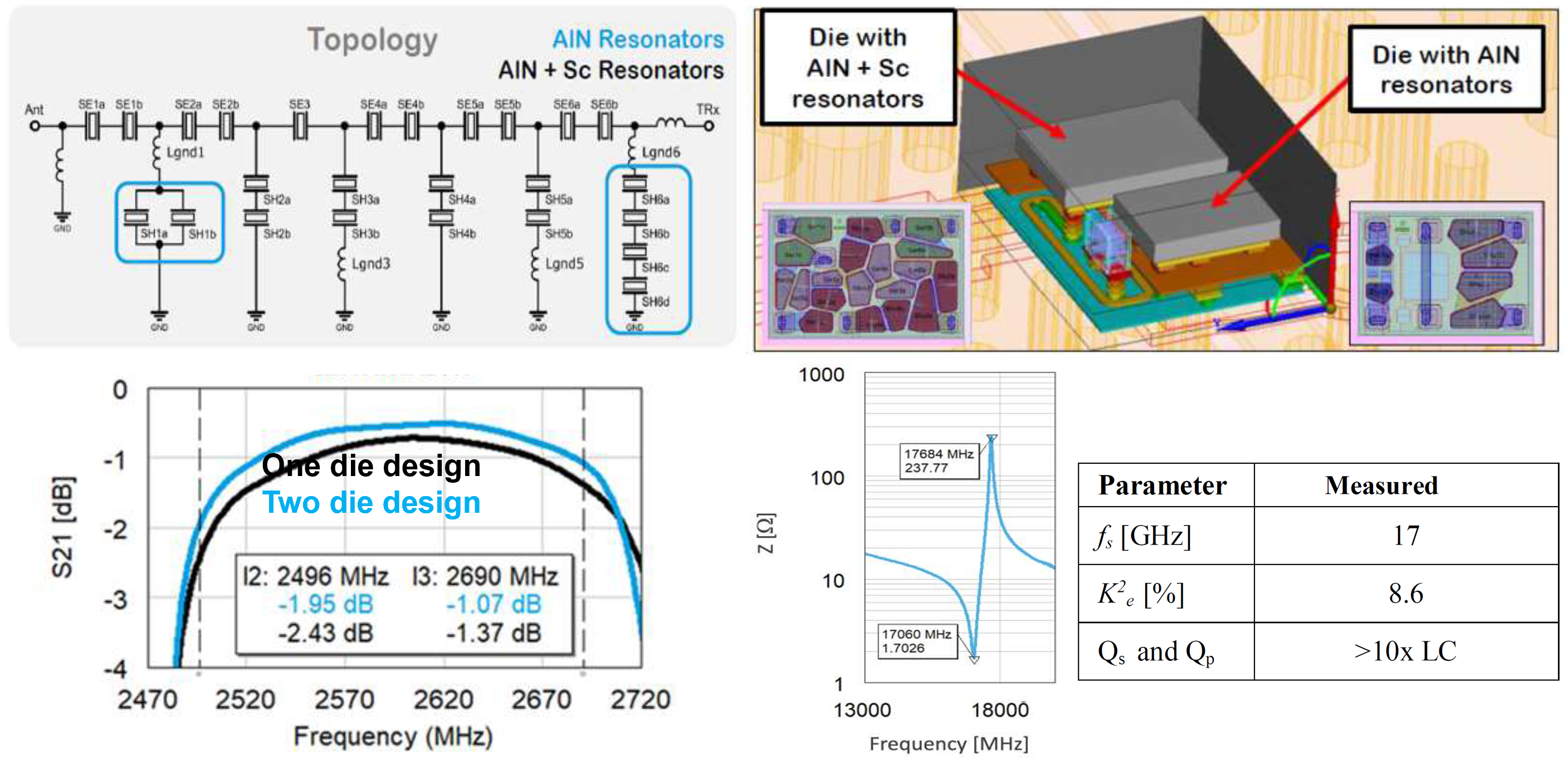 Heterogeneously integrated microwave & mmWave RF front-end modules with ScAlNRecord-setting resonators, filters, and heterogeneously integrated front-end modules beyond 10 GHz
MaterialProcessDeviceSystemPrior to Texas A&M
Advanced scandium-doped AlN bulk acoustic wave technology delivering more than 100% improvement in quality factor, over 50% reduction in TCF, and superior power handling beyond 10 GHz. Multi-chip heterogeneous integration of ScAlN and AlN resonators enabled filters with better insertion loss, sharper rejection, and up to 50% smaller die, and carried through to heterogeneously integrated RF front-end modules for 5G-Advanced and WiFi.
A. Tag et al., “Next Generation of BAW,” IEEE IUS 2022 · A. Tag et al., “Advances in BAW Technology Enabling 5G NR and WiFi6E,” IEEE UFFC-JS 2024
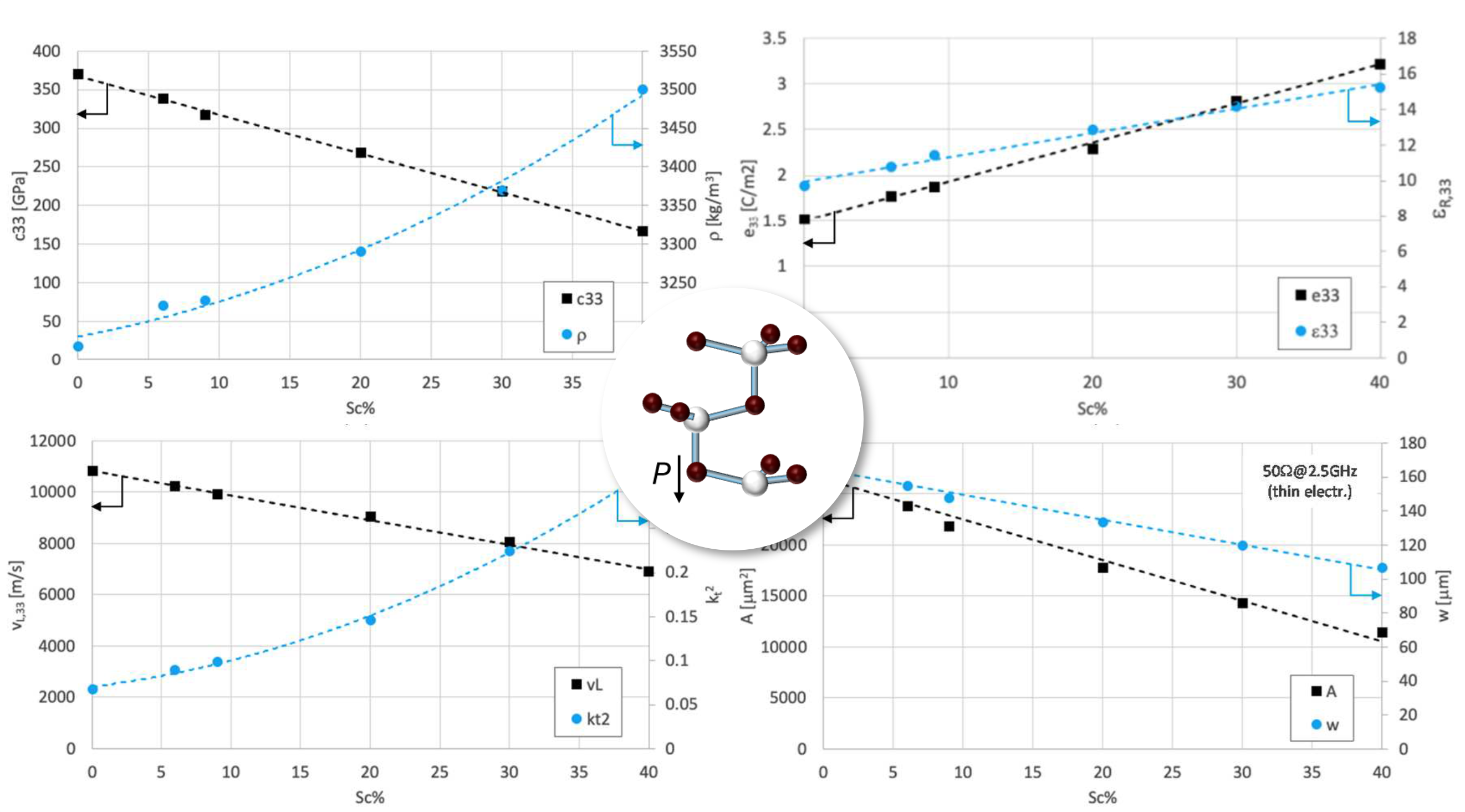 ScAlN: understanding the coupled electro-mechanical domainsTaming Sc-induced ferroelectric-like behavior for stable, high-Q resonators
MaterialProcessPrior to Texas A&M
Scandium incorporation fundamentally modifies AlN’s coupling, acoustic velocity, and dielectric response, introducing ferroelectric-like behaviors and coupled-domain interactions. Through precise characterization, optimized doping and etch processes, FEM modeling, and boundary engineering, we suppressed edge-related spurious modes and preserved quality factor, yielding ScAlN resonators optimized for reliable RF operation.
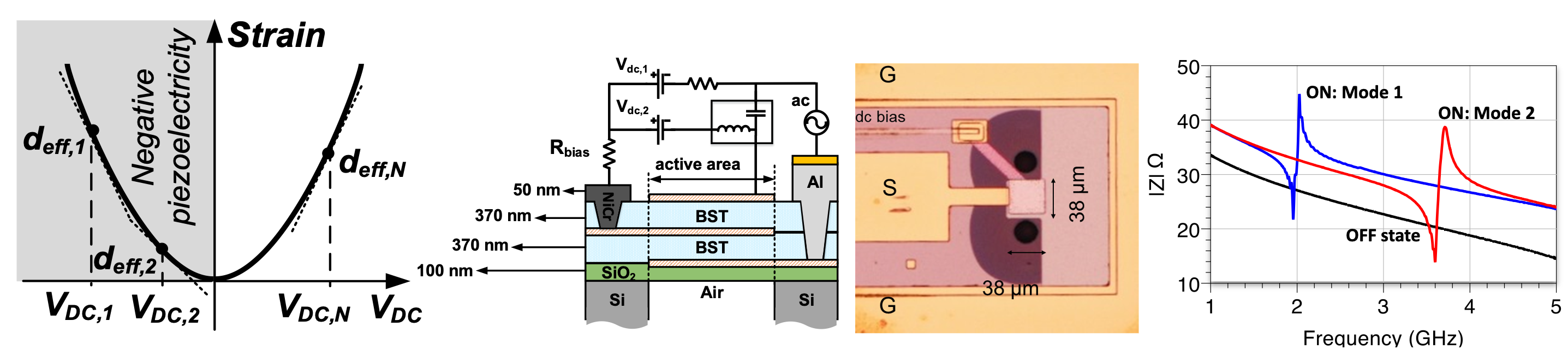 Programmable RF acoustics via nonlinear inhomogeneous transductionFirst band-switchable ladder filter with no external switches
ProcessDevicePrior to Texas A&M
Engineered BST heterostructures whose electromechanical transduction is defined by the applied field (electric-field-induced piezoelectricity), enabling selective excitation of resonance modes within a single device. A calibrated nonlinear electro-mechanical model guided predictive tuning of modal behavior and coupling, culminating in the first band-switchable ladder filter whose bands are accessed purely by bias, with no geometry change and no switches.
M. Z. Koohi and A. Mortazawi, IEEE TUFFC 2020 · IEEE IMS 2019
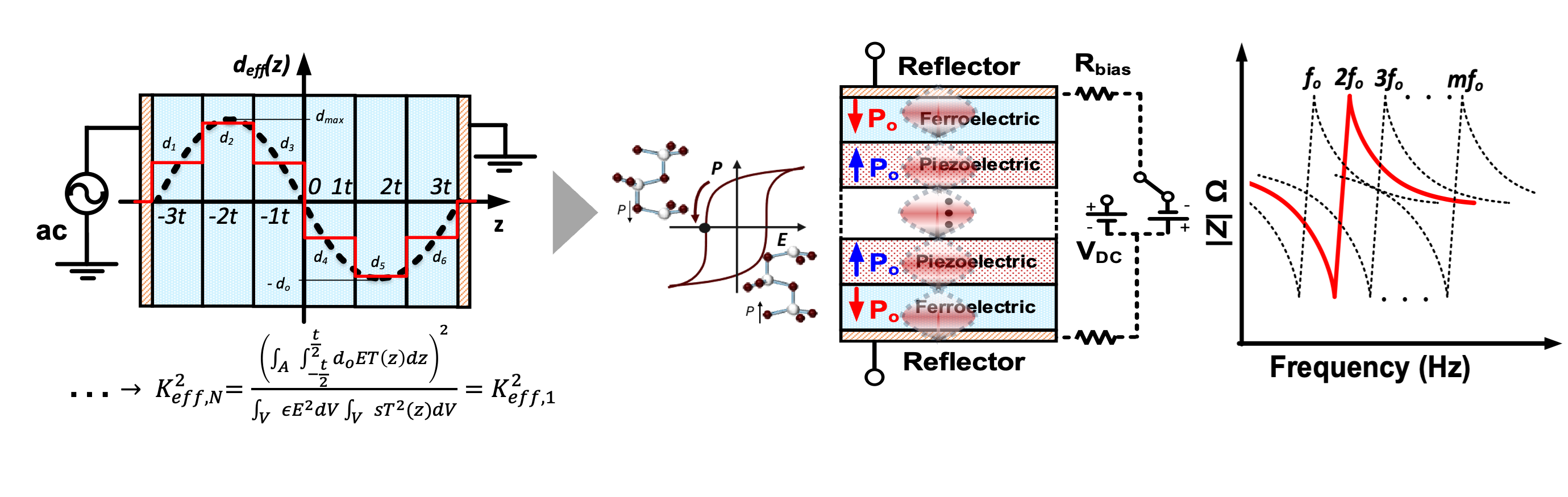 Breaking the Kt² harmonic limit through inhomogeneous piezoelectricityMode-selective coupling beyond the 1/n² decay law (US Patent, 2025)
ProcessDevicePrior to Texas A&M
First-principles analysis showing that spatial variation of the piezoelectric coefficient (via domain switching, electrostriction, or compositional gradients) breaks the symmetry mismatch that collapses coupling at higher-order harmonics. This enabled selective excitation of harmonic modes at mmWave frequencies with near-constant coupling, opening compact acoustic devices for 6G and beyond.
A. Mortazawi and M. Koohi, US Patent 12,206,388, 2025 · IEEE TUFFC 2020
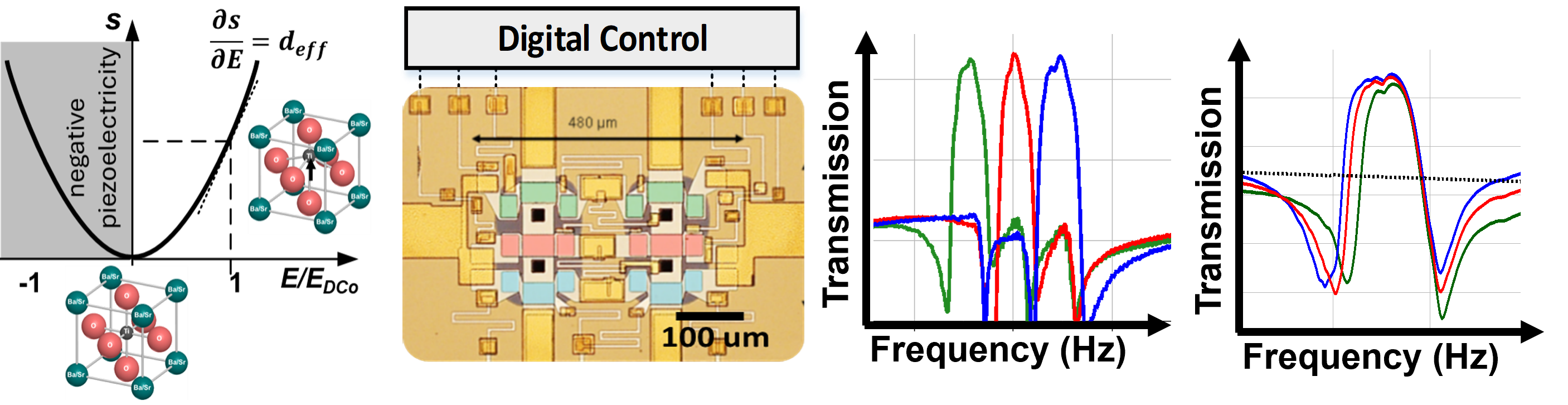 Agile RF front-ends: fully reconfigurable filter modules in complex oxidesIntrinsically switchable filters, filter banks, and electrically tunable bandwidth
ProcessDevicePrior to Texas A&M
A new class of intrinsically switchable RF filters exploiting giant electrostriction in paraelectric BST: acoustic transduction exists only under DC bias, so filters switch on, off, and between bands without lossy external switch networks. Demonstrated compact switchable FBAR filters, bias-selected filter banks, and bandwidth-reconfigurable BAW filters, reducing loss, area, and nonlinearity in the front-end.
IEEE Microwave Magazine 2020 · IEEE TUFFC 2020 · IEEE TMTT 2018 · IEEE TUFFC 2018
 Michigan BigHouse wireless system16-beam Butler-matrix Wi-Fi serving a 100,000-seat stadium
SystemPrior to Texas A&M
A high-capacity beamforming Wi-Fi platform for Michigan Stadium: a 16×16 Butler matrix feeding a 50-element ridged slot array forms sixteen 2.12° beams across a ~40° sector at 5.2 GHz, each carrying a dedicated Wi-Fi channel. Roughly 40 dB aggregate array gain enables reliable links from 10 dBm handsets at 200 m, solving interference and capacity in one of the densest wireless environments anywhere.
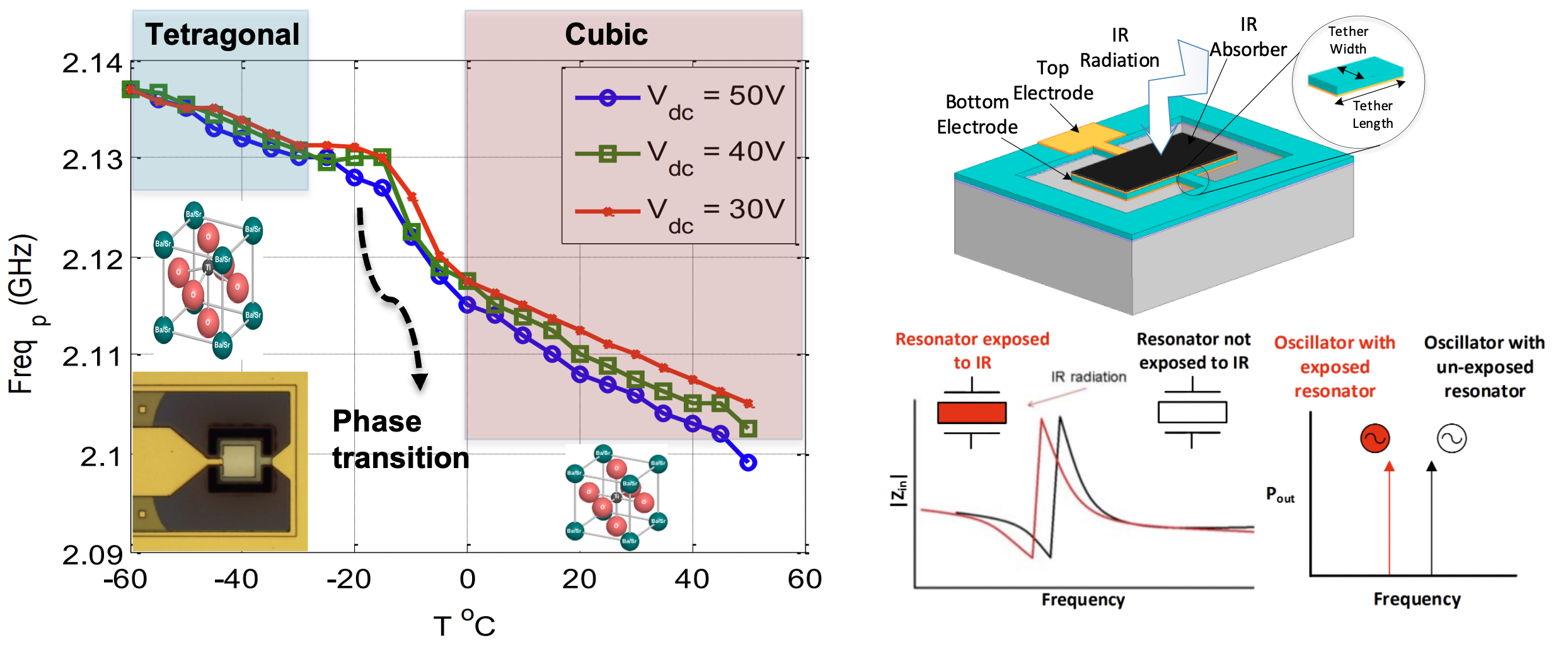 Phase-engineered BST thin films for uncooled IR sensingTCF of −921 ppm/K, more than 6× beyond state of the art
MaterialProcessDevicePrior to Texas A&M
First exploitation of BST’s tetragonal-to-cubic phase transition for resonant thermal detection: FBARs stabilized near the transition reached a temperature coefficient of frequency up to −921 ppm/K, with suspended-membrane thermal isolation down to 3.2×10⁻⁵ W/K, approaching theoretical NETD limits for uncooled IR detectors.
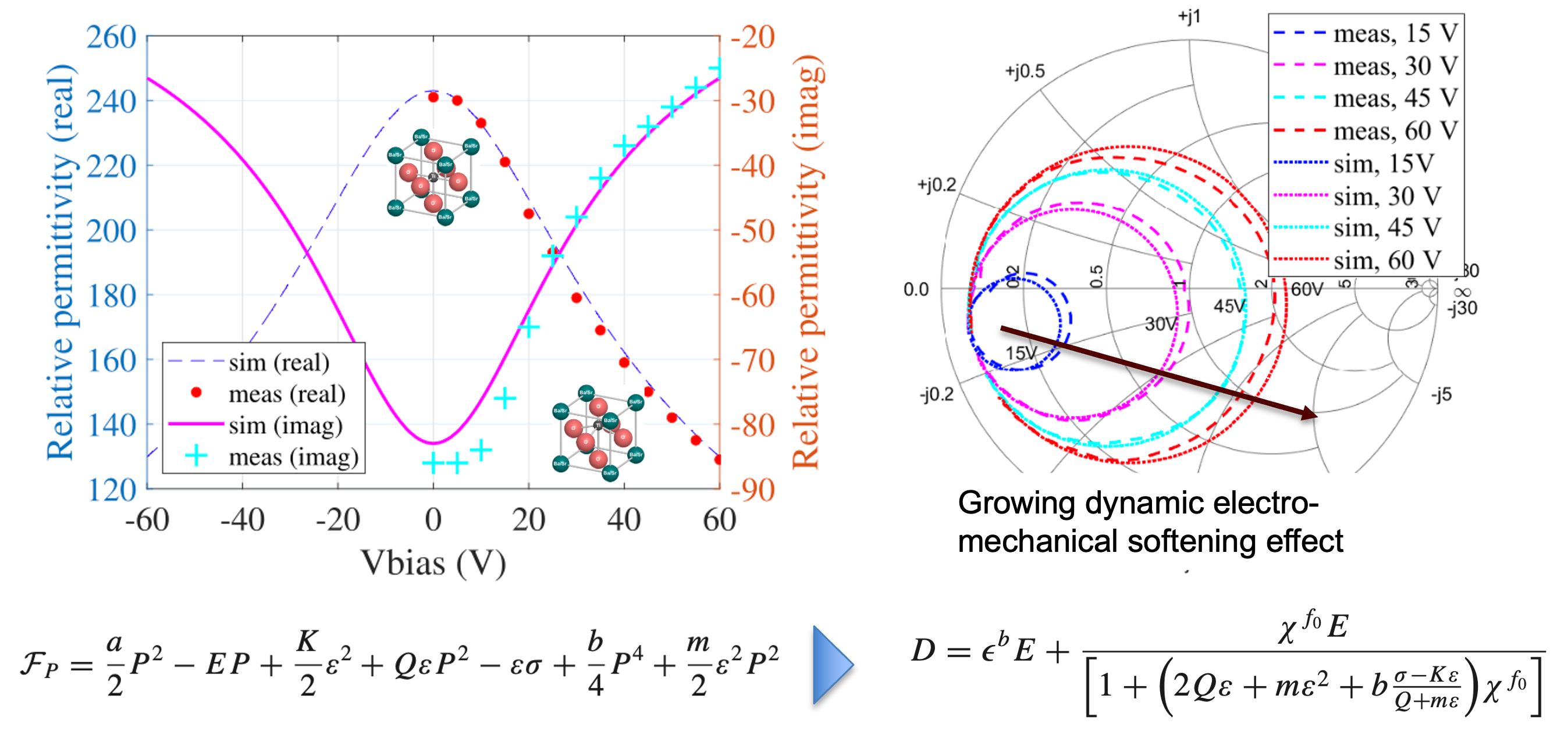 Giant electrostriction in barium strontium titanateRecord electromechanical coupling from a centrosymmetric thin film
MaterialProcessPrior to Texas A&M
By stabilizing BST in its centrosymmetric cubic phase, we isolated pure electrostrictive strain and extracted giant electrostrictive coefficients with record electromechanical coupling. A Landau–Devonshire thermodynamic framework linked polarization, field, and strain to bias-induced dynamic softening, connecting symmetry, microstructure, and defects to low-loss, highly tunable device response.
M. Koohi, Ph.D. dissertation, 2020 · W. Peng et al., IEEE TMTT 2022
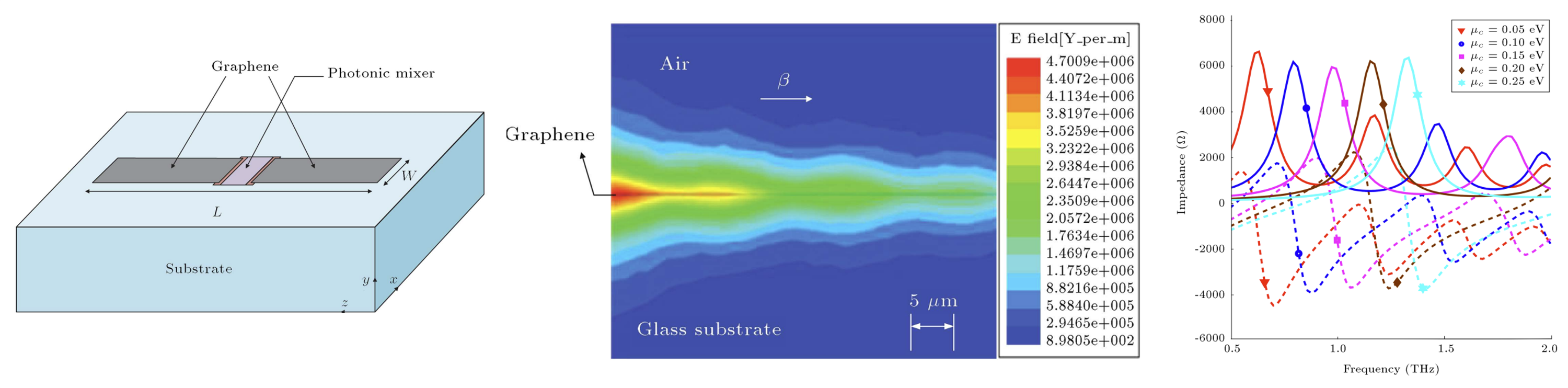 Graphene-based THz photoconductive antennasTunable plasmonic antennas with superior impedance matching
MaterialDevicePrior to Texas A&M
Full-wave study of graphene photoconductive antennas for THz generation and detection: plasmonic wave propagation yields ultra-miniaturized structures with higher input impedance for better matching to photonic mixers, and resonance tunable through graphene’s chemical potential. Multilayer designs significantly improve radiation efficiency toward practical 2D-material THz front-ends.
Sponsor or collaborate: see Funding & Partners, or email koohi@tamu.edu · Join the group: see our open positions.
